This Sunday, Lorilee led our Sangha discussion with a guided meditation by Joeseph Goldstein. The recoding she played is available here:
http://www.diydharma.org/guided-vipassana-meditation-joseph-goldstein
Vegan. Digital craftsman. Tea explorer. Avid learner of things. Writes code @automattic.
This Sunday, Lorilee led our Sangha discussion with a guided meditation by Joeseph Goldstein. The recoding she played is available here:
http://www.diydharma.org/guided-vipassana-meditation-joseph-goldstein
Sam led our Sangha this week on the topic of a phrase mentioned many times in Buddhist cannon: “the deathless”.
Sam chose excerpts from the following talks (from dharmaseed.org):
2016-03-27 Energy of Release – The Deathless Element – where Consciousness Finds no Footing 59:12
Ajahn Sucitto
Buddhist Retreat Centre : The Deeper You Go, the Lighter it Gets
2017-11-03 TBIF: on The Mula Sutta: Through the Portal of Self into the Non-Dual Heart 61:04
Thanissara
New York Insight Meditation Center : NYI Regular Talks
Here are the last lines of the Mula Sutta:
“‘All phenomena are rooted in desire.[1]
“‘All phenomena come into play through attention.
“‘All phenomena have contact as their origination.
“‘All phenomena have feeling as their meeting place.
“‘All phenomena have concentration as their presiding state.
“‘All phenomena have mindfulness as their governing principle.
“‘All phenomena have discernment as their surpassing state.
“‘All phenomena have release as their heartwood.
“‘All phenomena gain their footing in the deathless.
“‘All phenomena have Unbinding as their final end.’
From the Buddha:
In describing unsupported consciousness, the Buddha taught: Wherever there is something that is intended, something that is acted upon or something that lies dormant, then that becomes the basis for consciousness to land. And where consciousness lands, that then is the cause for confusion, attachment, becoming and rebirth, and so on. But if there is nothing intended, acted upon or lying latent, then consciousness has no basis to land upon. And having no basis to land, consciousness is released. One recognizes, ‘Consciousness, thus unestablished, is released.’ Owing to its staying firm, the heart is contented. Owing to its contentment, it is not agitated. Not agitated, such a one realizes complete, perfect nibbana within themselves. (Samyutta Nikaya 12.38 and 22.53)
And a quote from the book “As It Is” by Tony Parsons: “When I don’t know what I am I sanctify these experiences, take ownership of them and give them great significance. I believe they mean something which, once understood, will provide me with answers and formulas. But these experiences are only consciousness concealing and revealing itself in order to be recognized. When I know ‘what’ I am I discover that I am not existence; I am the presence which allows existence to be. Existence either blossoms in that presence or reflects back my sense of separation.”
And a quote from the book “I am That” by Nisargadatta Maharaj: “When you look at anything, it is the ultimate you see, but you imagine that you see a cloud or a tree. Learn to look without imagination, to listen without distortion: that is all. Stop attributing names and shapes to the essentially nameless and formless, realize that every mode of perception is subjective, that what is seen or heard, touched or smelt, felt or thought, expected or imagined, is in the mind and not in reality, and you will experience peace and freedom from fear. Even the sense of ‘I am’ is composed of the pure light and the sense of being. The ‘I’ is there even without the ‘am’. So is the pure light there whether you say ‘I’ or not. Become aware of that pure light and you will never lose it. The beingness in being, the awareness in consciousness, the interest in every experience — that is not describable, yet perfectly accessible, for there is nothing else.”
Today, Margaret shared a very deep talk with the sangha on the Mula Sutta as interpreted by Thanissara.
The link is: http://dharmaseed.org/teacher/178/talk/47371/
And here are the Pali and English translations of the last ten lines. These were taken from
http://obo.genaud.net/dhamma-vinaya/pali/an/10_tens/an10.058.pali.bd.htm
and
https://www.accesstoinsight.org/tipitaka/an/an10/an10.058.than.html
respectively.
On January 21, Michael offered a presentation on the Distraction and Dharma. His interest piqued by the effect of increasing, even compulsive use of digital devices on the part of the general population (himself included), he put together the observations of several respected teachers on the subject of the kinds of distractions that we actually seek out – rather than those which intrude despite our best efforts.
Here are links to his sources.
Gil Fronsdal’s talk “Distraction and Attention” examines the effects of a distracted versus a focused mind, as these are examined scientifically and approached dharmically. Find this talk on http://www.audiodharma.org/talks/?search=distraction dated 2015/11/1. The excerpts used this Sunday were minutes 8:0814:07 and 25:06- 33.27.
Martin Aylward’s talk “Defenses Against Spaciousness” proposes that distraction, a form of delusion, holds a place equal to grasping and rejecting, in keeping us from the dharma, and particularly from the experience of open space. The talk can be found at http://dharmaseed.org/teacher/200/talk/18936/ The excerpt used was minutes 34:31-38:45.
Finally, here is the article which Michael read at the end of our gathering. https://tricycle.org/trikedaily/cool-boredom/
This Sunday, Zac led our Sangha discussion exploring the question, “what is insight?”.
He played an excerpt from a talk by Rob Burbea and read from the Samanupassana Sutta: Assumptions.
To enter with mindful intention into the new year, Joey drew from Sally Clough Armstrong’s dharma talk on the Fourth Foundation of Mindfulness. This talk offers an overview of the many roads that through practice can lead to liberation.
Sangha New Years Eve Day 2017/8
In this season of sincere resolutions often not skillfully made, our focus was on wise intention, the second step of the eightfold path. Michael led our reflections, beginning with a look at the inscription on the wooden Han which is struck with a mallet to call monks to meditate at Soto Zen monasteries (Here, Tassajara).
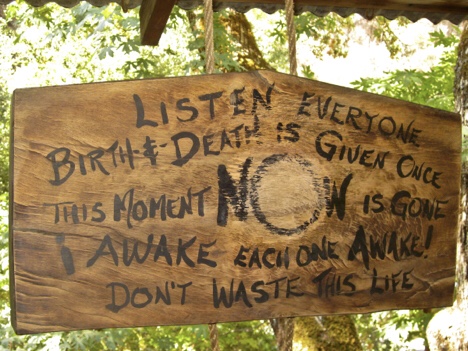
Listen Everyone. Birth & Death is Given Once. This moment Now is Gone.
Awake each one Awake! Don’t Waste This Life
We explored the ways in which advice about how to make and keep resolutions seemed to support or ignore wise intention. Most of the advice given is of the ‘true grit’ variety, just bring yourself to follow your resolutions with will power. Research has shown this approach lasts on average until January 8 before the resolutions collapse.
A more discriminating approach can be found in the NYT article titled “How to Make and Keep a New Years Resolution” which focuses on the processes by which bad habits are cued, and (those cues seen) can be replaced by more wholesome habits.
https://www.nytimes.com/guides/smarterliving/resolution-ideas
The Buddha’s advice about modifying one’s own behavior can be discovered in his counsel to his son Rahula, which is the subject of dhamma talks by Ajahn Lee Dhammadaro and Ajahan Thanissaro. Here, a rational and an empirical analysis of one’s behavior and its effects on oneself and other can lead to action purified of delusion and harm.
https://www.accesstoinsight.org/lib/thai/lee/pathtopeace.html
A contemporary approach which is consonant with dharma wisdom while being offered in a secular forum, is offered in the New York Times Sunday Review for December 29,2017, under the title “The only Way to Keep Your Resolutions.” David DeSteno’s extensive research has led him to focus on the emotional ground or mindset in which resolutions are being undertaken. His research has demonstrated that self control and delayed gratification, characteristics of most people who reach their goals and achieve a real measure of happiness, are richly supported by taking time to reflect on gratitude, compassion, and justifiable pride or sense of accomplishment. As you know, at least two of these reflections are supported by classical Buddhist meditations. He makes the most complete connection between the overall mindset out of which action proceeds, and the effect of those actions on the person undertaking them. His article is worth reading in full
https://www.nytimes.com/2017/12/29/opinion/sunday/the-only-way-to-keep-your-resolutions.html?_r=0
In sum, since the Buddha himself placed Wise Intentions early in the path of practice, we might do well to give it the kind of thoughtful attention that could really improve our lives and the lives of those around us.
Christmas Eve Day Sangha
Michael guided our reflections this morning, with a focus on faith or trust, with an aim toward looking into what it is that we trust in ourselves, and what we have learned not to trust.
The holidays present us with the apparent demand that we trust in religious faith, or communal celebratory spirit, and it can be useful to have a balance against that pressure, to allow us to look into our selves, and find what, amid the changing surfaces of life, seems constantly reliable. Strategies for protecting that space are the subject of this poem by Naomi Shihab Nye:
The Art of Disappearing.
When they say Don’t I know you? say no.
When they invite you to the party
remember what parties are like
before answering.
Someone telling you in a loud voice
they once wrote a poem.
Greasy sausage balls on a paper plate.
Then reply.
If they say we should get together.
say why? It’s not that you don’t love them any more.
You’re trying to remember something
too important to forget.
Trees.
The monastery bell at twilight.
Tell them you have a new project.
It will never be finished.
When someone recognizes you in a grocery store
nod briefly and become a cabbage.
When someone you haven’t seen in ten years
appears at the door,
don’t start singing him all your new songs.
You will never catch up.
Walk around feeling like a leaf.
Know you could tumble any second.
Then decide what to do with your time.
The process of establishing boundaries sketched in, we then turned to contemplate what it is we might trust all the way down. Prompting our conversation on this subject was an 11 minute video by spiritual teacher Gangaji. The particular talk that we watched is not available for circulation, but there are plenty of talks on trust by Gangaji available on YouTube. Here’s a link to a talk she gave introducing a retreat devoted to the topic. https://www.youtube.com/watch?v=n8vG1X75oOE&t=24s
Our conversation ranged broadly, anchored by a respect for right wisdom about how best to spend our time to cultivate a new birth in our own lives.
This Sunday, Rebecca led our reflections, focusing on a text by Swami Ramachakara (William Walker Atkinson) on Gnani Yoga as a way to approach The One.
She read from “Gnani Yoga, the Yoga of Wisdom,” Lesson 1, “The One,”.
Joey led our reflections this past Sunday. To understand the four Brahma Viharas–lovingkindness, compassion, joy, and equanimity–as embraced within the larger framework of Empathy can give new depth to our understanding, new life to our practice.
Here are the talks she played:
Brahmaviharas as relational practices by Akincano Marc Weber
http://dharmaseed.org/teacher/360/talk/43576/
Practicing with Views and Opinions: Cultivating empathy Donald Rothberg
http://dharmaseed.org/teacher/55/talk/37382/
“For Warmth
I hold my face in my two hands.
No, I am not crying.
I hold my face in my two hands
to keep the loneliness warm –
two hands protecting,
two hands nourishing,
two hands preventing
my soul from leaving me
in anger.”― Thich Nhat Hanh, Call Me by My True Names: The Collected Poems
Compassionate action starts with seeing yourself when you start to make yourself right and when you start to make yourself wrong. At that point you could just contemplate the fact that there is a larger alternative to either of those, a more tender, shaky kind of place where you could live.
– Pema Chodron
