Last week we heard from Brian Lesage about not taking things personally. This week, courtesy of Lorilee, we again hear from Brian and deepen our knowledge of the Buddha’s teachings about nature, in a talk he gave May 3rd this year “Being Aligned with the Dharma & Ecological Perception”.
It is prescient that over 2 millennia ago, the Buddha actually taught that one of the conditions “that prevents the rain from falling” is when we people are not aligned with the Dharma. Whether we are aligned with nature or not, affects our planet. This is not surprising, given that we are not separate from, but part of, nature.
How often do we feel harshly put upon when things don’t go according to our liking? A big tree falls on your car. The doctor’s office calls with the seriously bad results of your test. The drain in your shower is clogged. Your computer freezes and won’t do anything. Ants show up at your picnic. Oh, it all seems so unfair.
Do we see these as the results of causes and effects? We should be able to deal with things. We still have our equanimity, right? Maybe we indulge in a bit of self-pity or feel like we are under attack. What kind of habits are we cultivating?
This week’s Sangha was led by Don S. and featured a talk by Brian Lesage. You can listen to the talk here:
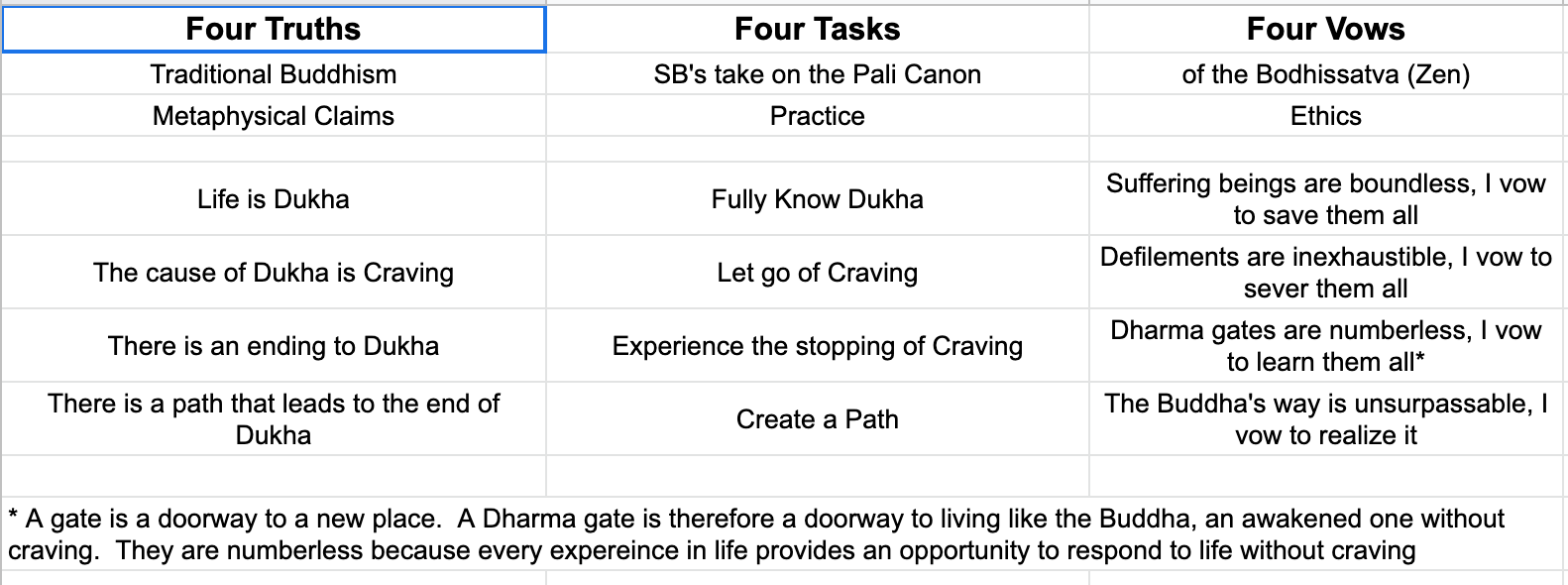
What are the Four Noble Truths? Buddhist practice epouses practice and insight, and yet the core teaching of the path is a short list of statements. How can we look at this teaching from another perspective? Perhaps the Truths are meant to be activity rather than philosophy.
This week Eric played a talk by Stephen Batchelor on the Four Noble Truths and how they are reflected in traditional vows taken by some monastic traditions.
The point is that each of these “truths” is something to be acted upon in a specific way. The point of the Dharma is not to persuade yourself that life is suffering… the point of the practice is to embrace suffering. It’s to fully know Dukkha… To say “yes” to the life situation that confronts you in this moment. These are tasks to be recognized, performed, and accomplished. They are not truths to be believed or disbelieved.
Stephen Batchelor
You may wish to examine this chart as a reference to the comparison of the Four Truths, the Four Tasks, and the Four Vows:
The natural world offers us readily accessible opportunities to become intimate with the wisdom and qualities we work so hard to cultivate in enclosed spaces. Bringing our bodies and our senses into the present, nature reveals the laws of dharma, things just as they are.
Mark Coleman’s talk, “The Wisdom of Nature Practice,” presents a unique way of being in nature. In it he describes the art of being outdoors with a contemplative presence and points us to the insights that can be derived by practicing it. Stephanie brought this talk to our sangha this week.
The time before, during, and after the teaching career of the Buddha were rich in other Wisdom traditions worldwide. Some of these can shed light on the dharma with implications for a richer practice. Michael guided our discussion of these intersections this week and their possible potential.
Some quotes from the talk and discussion:
Lost
Stand still.
The trees ahead and the bushes beside you are not lost.
Wherever you are is called Here.
And you must treat it as a powerful stranger.
Must ask permission to know it and be known.
The forest breathes. Listen. It answers.
I have made this place around you.
If you leave it you may come back again, saying Here.
No two trees are the same to Raven.
No two branches are the same to Wren.
If what a tree, or a bush does is lost on you, You are surely lost.
Stand still.
The forest knows where you are.
You must let it find you.
—from the Indigenous American tradition
Instructions for Living a Life Pay attention. Be astonished. Tell about it.
—Mary Oliver
To be happy you must have taken the measure of your powers, tasted the fruits of your passion, and learned your place in the world.
While it’s not a new phenomenon by any means, the physical distance created between people by the Pandemic has made the topic of social anxiety much more ubiquitous in our culture. The fear of judgement by others, always present in our minds, can suddenly be debilitating. This can make everyday activities become traumatic events and it can be challenging to explain such behavior to our friends and loved ones since doing so reinforces that very fear. We may sense further judgement from ourselves to just “deal with it”. What can Buddhist practice offer us as a real antidote to this experience? In this week’s Sangha, Payton explored the topic of social anxiety, using Buddhism’s practices to see how it functions and what we might be able to do about it.
When I have social anxiety it feels like this:
Fear of not knowing what to say and not being prepared.
Fear of saying the wrong thing.
Fear of what I say causing the other to dislike me.
Exhaustion with having to become who the other expects me to be.
Fear of disappointing the other or not being what they need from me.
Exhaustion with having to read the words and body language of the other in order to understand what they really mean.
Exhaustion with having to summarize my experience in a way that others can understand.
Discomfort of having to context switch from something I’m focused on.
A summary of my exploration of this topic:
What is happening? I am anxious about judgement and work hard to make others comfortable.
Why is this happening? A lack of self-confidence and fear of the unknown.
What practices may help? Remembering the eight worldly winds, remembering that no one is immune to blame, returning to the body, willingness to stay with suffering and not escape, touching the earth, practices of impermanence, and all practices of not-self.
Verse 227: It is not new, O Atula! It has always been done from ancient times. They blame one who is silent, they blame one who speaks much, they blame one who speaks little. There is no one in this world who is not blamed.
Verse 228: There never has been, there never will be, nor is there now, anyone who is always blamed or always praised.
I want others to feel comfortable but doing so is a lot of work.
Why do I want others to be comfortable? Because in their place I would want to be comfortable. For strangers, it’s also because comfortable people are less likely to be dangerous/make me uncomfortable. So the motivation is both kindness and fear.
Why is it a lot of work? Because I have to stop paying attention to my own needs and instead read the other and adjust my behavior with all my awareness. Depending on conditions this can be easy or hard. With less information, like when I’m on a phone call, this is more difficult still.
Due to the effort required, even thinking about social interaction can be aversive and causes me to avoid interactions entirely, particularly when I am tired or stressed.
Underlying beliefs that cause this are a lack of self-confidence and fear of the unknown. I feel inherently unlikable and that my behavior may make others uncomfortable. Uncomfortable people at best don’t want to be friends and at worst may want to cause me harm.
A brief talk on the topic of social anxiety:
Here’s some additional material I gathered as part of the research for this talk:
We need suffering in order to see the path. The origin of suffering, the sensation of suffering, and the path leading to the cessation of suffering are all found in the heart of suffering. If we are afraid to touch our suffering, we will not be able to realize the path of peace, joy, and liberation. Don’t run away. Touch your suffering and embrace it. Make peace with it. Buddha said, “the moment you know how your suffering came to be, you are already on the path of release from it.“ If you know what has come to be and how it has come to be, you are already on the way to emancipation.
– The heart of the Buddha’s teaching by Thich Nhat Hanh
Last week’s sangha conversation ended on the topic of dealing with the dissatisfaction of our current worldly condition and the ‘death of optimism.’ This week, Evelien played off of that topic and the concept of ‘death and rebirth’ with Mark Nunberg’s talk called ‘Meeting and Healing the Unresolved Pain in the Heart’.
Mark Nunberg talks about the difficulty of trying to be present when something is asking for our attention. This could be something from our past, which is Mark’s focus, but it could also be a concern with the present or fear for the future. Mark discusses that a gratitude, metta, or appreciative joy practice may be the medicine that can help our heart digest and process this pain, not dismissing it, but bringing it to a point of healing.
On this Easter Weekend, Drawing on a talk by Matthew Brensilver, Sam guided our reflections on the themes of death, renewal and rebirth from the Buddhist point of view. Points of divergence, similarity, and resonance between the Christian and Dharmic perspectives can enhance our sense of the meaning of this season for all.
Sam played excerpts from these talks:
Death and the Poignancy of Life, by Matthew Brensilver, 12-17-19
There is comfort in the dharma’s ability to remain relevant and impactful over thousands of years. Yet while these seemingly timeless universal truths can anchor our navigation of the life experience, at times it can be important, if not essential, to pause and consider how the teachings pertain to the uniqueness of life on earth at this moment. This week’s presentation examined one practice of the Eightfold Path that especially benefits from consideration of these dual perspectives: Right Action.
Andrea drew from talks by Andrea Fella and Jill Shepard to provide a brief overview of Right Action, offer its basic historical foundation, and translate the intentions into modern day application. Selected subtopics of moral weight, vegetarianism, and an expanded understanding of abstaining from stealing complicate our thinking on Right Action in contemporary times.
Here are the three talks about Right Action excerpted today:
The idea of staying mindfully present seems so elegant and simple. Why is it so difficult to do? Borrowing metaphors from a recent talk by Mark Nunberg, instead of maintaining attention on what is being known in the moment, we get “lost in the whirlpools of the mind,” and our minds create narratives for experience, “reacting to reverberations of kharma”. This Sunday, Margaret drew from a talk by Matthew Brensilver to explore how our memories of the past and our ruminations about the future relate to our attempts to be fully in the present.